


1870’s
In what is popularly know as the first wave pool, Bavarian King Ludwig II built The Venus Grotto, an underground labyrinth with aquatic passageways and an electric “wave maker.” It is thought he escaped to the undulating wave maker to escape the pressures of being King, not unlike surfers escaping their daily pressures by riding waves.
1929
In November, a British news reel titled Indoor Surfers shows a pool in Germany equipped with agitators that create waves. The precursor to the “body bobber” types of wave pools found in waterparks today.
1934
In Wembly, UK, a pool is equipped with hydraulic technology that created ripples, similar to the ocean. While not significant enough to “ride,” we are getting closer.
1964
An article in Surfer Magazine introduces the “Surfatorium” in Hachijoi, Japan – the first indoor wave pool of significance – measuring 120 ft wide x 195 ft in length.
1969
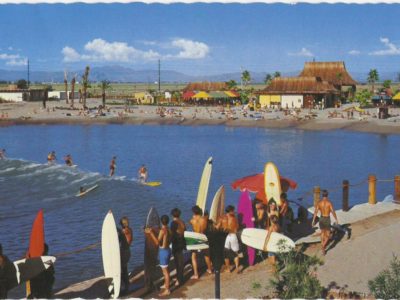
Big Surf, Tempe Arizona. This was big news at the time, and featured in Sports Illustrated. Designed by Phil Dexter and financed by Clairol Hair Products, Big Surf can produce a 3 foot wave every 40 seconds, that can be ridden for up to 20 seconds. Fifty years later, it is still in operation.
1985
Dorney Amusement Park, Allentown, Pennsylvania introduces the Wildwater Kingdom wave pool. There is actually an ASP (Association of Surfing Professionals) specialty event there with a prize purse of $25,000 – pretty big money for a tragic, gutless event attended by the best surfers in the world and won by Tom Carroll.
1987
Palm Desert unveils a small wave pool that provides two ft, gutless surf. The top pros in California of the day drive two hours to compete in an event sponsored by Budweiser. Jim Hogan wins the top prize of $1,500, and claims it to be bigger than the surf in San Clemente, Ca that weekend.
1988
In another feeble attempt to run a competition in a wave pool, Australian Damien Hardeman beats Martin Potter to win the ASP rated Marui Wavepool Pro in Japan. The surf in the pool can only be described as a novelty – it sucked. Just look it up on Google.
1988
Charles Sauerbrier and Tom Lochtefeld file patent application 286974 for “A wave-forming generator for generating inclined surfaces on a contained body of water.” This is the birth of the flying reef – more on that later.
1989
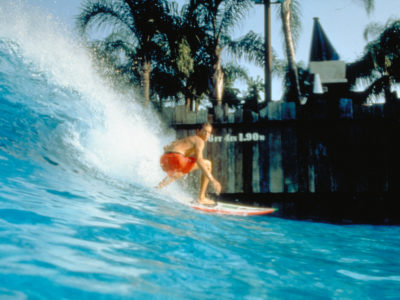
Typhoon Lagoon opens at Disney, Orlando. Built by Whitewater West Industries, the wave offers a one to seven ft peak breaking both ways every 90 seconds. The pool is 500 ft long x 126 ft wide, holding 2.6 million gallons of water… and yes, still operates to this day.
1991
Schlitterbahn in New Braunfels, Texas, opens the first stationary wave system from Wave Loch. The future is born, and it’s successor, the FlowRider® becomes the most successful artificial wave in the world.
1993
In Miyazaki, Japan, Mitsubishi spends hundreds of millions of dollars on the Sea Gaia Ocean Dome complex. Part of the worlds largest indoor waterpark, the wave pool holds 13,500 tons of water, and creates what many consider the best surfboardable artificial wave yet. Later that year, Fabio Gouveia wins the first wav epool event held there. The venue closes in 2007 as part of a new hotel renovation and development.
1993
Sunway Lagoon in Malaysia opens, but basically caters to swimming tourists, at least until Red Bull ad Rip Curls use Sunway as a backdrop for their own efforts. Billibong delivers a 4 minute segment featuring top pros Taj Burrow, Joel Parkinson, and Trent Munro ripping the pool to shreds.
1997
In June, a young Kelley Slater wins a $20,00 ASP specialty event at Typhoon Lagoon. Rob Machado states “I’d rather surf Typhoon than Huntington Beach – at least I know I will get my wave count.”
2000
Madalay Bay Resort and Casino invites Laird Hamilton to ride their new wave pool, but it has quite a few design issues and never gains traction – poof.
2005
Jose’ Manuel Odriozola and Karin Frisch found Wave Garden. Using a unique “formula” for wave generating equipment, their development continues for the next decade in the Basque country.
2007
Kelly Slater Wave Company is founded.
2011
– Wadi Adventure opens in Al Ain in the UAE. It’s the first surf pool in the UAE, and is also built by Murphy’s Waves, with claims of waves up to 10 ft.
2008
Murphy’s Waves install their first surf pool system in Siam Park in Tenerife, in the Canary Islands. Included are an onsite desalination plant. Waves up to eleven feet are said to be produced, although the is no imagery to support that.
2015
Wave Garden opens their first full powered wave at Snowdonia. It claims to have 6 ft waves that peel down the line for 20 seconds and is basically a generator hull being pushed through the water. Wave frequency is an issue, but not as much as the mechanical problems that shut the venue down for 6
months.
2015
December – On a chilly morning in Lemore, CA, Kelly Slater Wave Company introduces the world to the best artificial surfing wave to date. A long, perfect cylinder in the 4 ft range, it is something to behold. The technology is a “wave shape” (generator hull/hydrofoil) weighing 100 tons, being powered down a track at 18 mph. Besides the frequency (1 wave every 4 mins), power and infrastructure cost will surely be an issue in the future.
2016
Nland Surf Park opens in Texas. The second Wave Garden product pushing a generator hull through the water. The park is beset with challenges, from water quality to ripped liners to equipment reliability.
2018
BSR Surf Resort, by American Wave Machine enters the scene and is a huge success. Programmable waves from barrels to air sections, this is now the benchmark for an artificial surf wave experience. The wave allows surfers to learn more in one day than what they may learn in a year.
2020
URBANSURF opens in Melbourne. It is the new Wavegarden Cove product, that utilizes a paddle system to create the waves and frequency. They seem to have abandoned the generator hull concept for obvious reasons. It also produces the gnarliest small barrel of all of the competitors. A huge hit in the Melbourne area.
2020
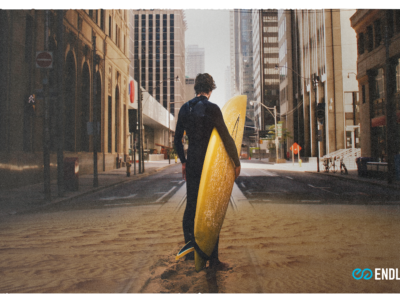
May – Whitewater West introduces Endless Surf™. The product is based upon 40 years of making waves, and there will be more to come.